Nearly 200 Years of Rail History
The corridor Finger Lakes Railway operates today traces its origin to the Auburn and Syracuse Railroad, incorporated in 1834, placing it among the oldest continuously operated industrial rail routes in North America. This is that story.
"When the first rails were laid in this corridor, the United States had fewer than 1,200 miles of operating railroad. The Finger Lakes was already among them."
Auburn & Syracuse Railroad, incorporated May 1, 1834Few short line railroads in the United States can claim a history as deep as the one that runs beneath Finger Lakes Railway's wheels today. The main corridor connecting Syracuse to the Finger Lakes was first surveyed and graded in the mid-1830s, before the telegraph, before the Civil War, before most of America's iconic rail lines existed at all. What began as a modest connection between Auburn and the Erie Canal has evolved through nearly two centuries of economic change into one of Upstate New York's most vital freight rail arteries.
-
1834
Auburn & Syracuse Railroad Incorporated
On May 1, 1834, the Auburn and Syracuse Railroad was incorporated by the State of New York, one of the earliest chartered railroads in the United States. Its mission was to connect Auburn with the Erie Canal at Syracuse, linking Central New York's agricultural heartland to the waterway commerce moving goods east and west across the state.
-
1835–37
Construction Begins and Stalls
Grading and construction began in 1835, but the Panic of 1837, a severe financial crisis that swept the young nation, halted progress and strained the railroad's financing. The project would be paused and restarted before finally reaching completion.
-
Jan. 8, 1838
The Line Opens
The Auburn and Syracuse Railroad opened for service on January 8, 1838. In its earliest days, the line operated with horse-drawn trains. Steam power was not yet standard, and the track quality of the era made horse traction a practical starting point for passenger and light freight service along the route.
-
June 14, 1839
First Steam Locomotive Introduced
On June 14, 1839, the railroad introduced its first steam locomotive, named the Syracuse. It was a turning point: steam power dramatically expanded the line's capacity, speed, and commercial potential, and marked the Auburn & Syracuse's transition from a novelty into a genuine freight and passenger carrier.
-
Aug. 1, 1850
Merger: Rochester & Syracuse Railroad
The Auburn and Syracuse Railroad merged with the Auburn and Rochester Railroad on August 1, 1850, forming the Rochester and Syracuse Railroad. The combined line now connected Syracuse westward through Auburn to Rochester, a far more commercially powerful route, spanning the heart of Central and Western New York.
-
1853
Absorbed into the New York Central Railroad
In 1853, the Rochester and Syracuse Railroad was absorbed into the New York Central Railroad, the emerging giant of American rail. The NYC would grow into one of the most powerful rail systems in the world, and the former Auburn Road became a key link in its sprawling Upstate New York network, carrying passengers and freight for the next century.
-
1940s–50s
Wartime Service and the Seneca Army Depot
During World War II and through the Cold War era, the Kendaia branch line of this corridor played a critical strategic role, serving the Seneca Army Depot, a major military installation in Seneca County. The railroad moved ammunition, materiel, and supplies that supported the nation's defense posture through decades of global conflict.
-
1958–68
Penn Central and the Beginning of Change
As passenger rail declined nationally and major railroads struggled financially, the corridor passed through Penn Central after its formation in 1968. Penn Central's collapse and subsequent bankruptcy in 1970, the largest in US history at the time, set the stage for the federal restructuring of northeastern rail that would reshape the corridor once more.
-
1976
Conrail Takes Over
The federal government created Consolidated Rail Corporation (Conrail) in 1976 to absorb the bankrupt Penn Central and several other failed northeastern railroads. The Finger Lakes corridor, along with former New York Central, Pennsylvania Railroad, and Lehigh Valley Railroad trackage in the region, came under Conrail's umbrella, preserved as a functioning freight artery through difficult decades.
-
July 23, 1995
Finger Lakes Railway is Born
On July 23, 1995, Finger Lakes Railway began operations as an independent Class III short line railroad, acquiring 150+ miles of track from Conrail across six Upstate New York counties. A corridor that had been part of corporate giants for over a century was now in local hands, operated by a team focused exclusively on the Finger Lakes region and the customers who depend on it.
-
1998
Seneca Army Depot Service Concludes
The Seneca Army Depot, which had been served by the railroad's Kendaia branch throughout the Cold War, officially closed in 1998, ending a half-century of military service along that line. The corridor's industrial and agricultural freight base would carry the railroad's growth into the 21st century.
-
Today
A Legacy Still Running
Today, Finger Lakes Railway operates 150+ miles of track across Onondaga, Cayuga, Seneca, Ontario, Schuyler, and Yates counties, moving more than 18,000 freight cars annually with a fleet of 13 locomotives. The 76-mile main line from Syracuse to Canandaigua still follows the general alignment first surveyed nearly two centuries ago. The names on the locomotives have changed. The mission has not.
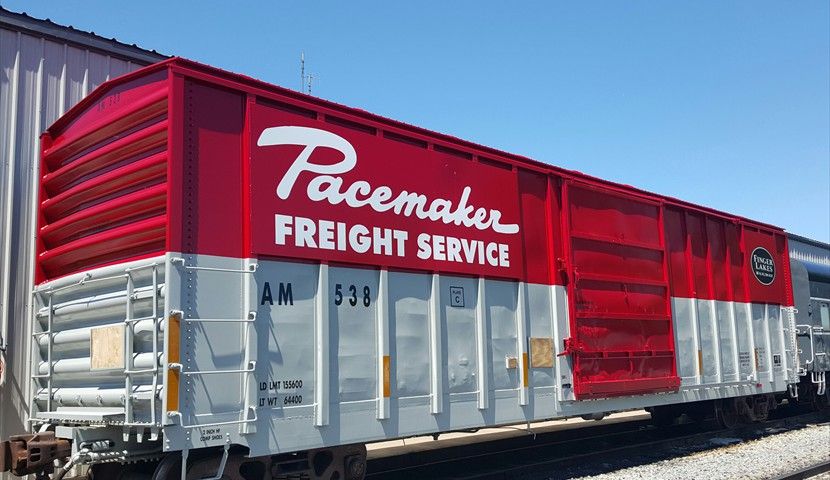
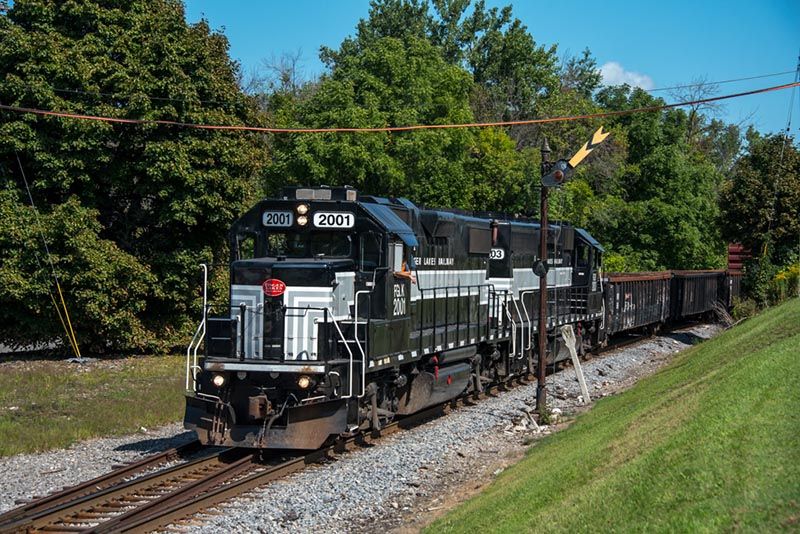
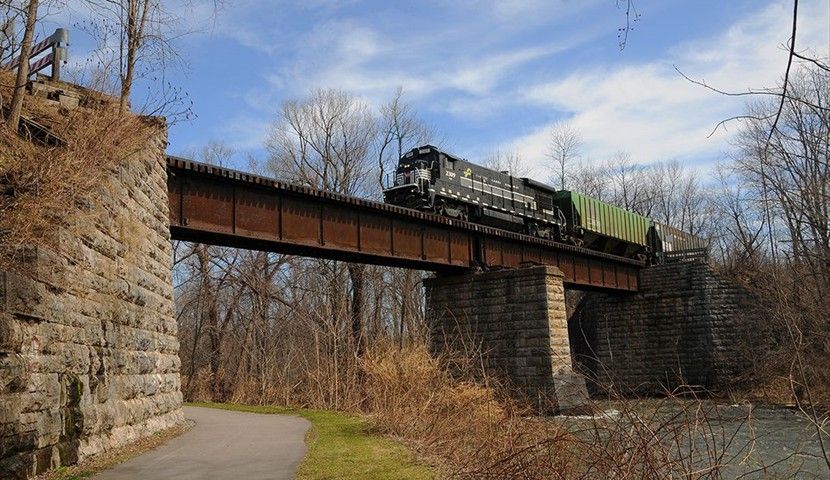
One of the Oldest Industrial Rail Corridors in North America
When the Auburn and Syracuse Railroad was incorporated in 1834, the United States had been a nation for fewer than 60 years. The transcontinental railroad was still 35 years away. The Finger Lakes corridor was laid down in the same decade as the Baltimore & Ohio, the South Carolina Railroad, and the earliest lines of what would become the New York Central, a peer of the very railroads that built industrial America.
That original alignment, from the Erie Canal at Syracuse through Auburn and into the Finger Lakes, has carried freight through the Erie Canal era, the Industrial Revolution, two World Wars, the Cold War, and the post-industrial transition of Upstate New York. Today's Finger Lakes Railway is the latest steward of a corridor that has been continuously moving commerce for nearly two centuries. That is not a footnote. That is a foundation.
The Predecessor Railroads
The track Finger Lakes Railway operates today was assembled from three of the most historically significant railroads in American history.
New York Central Railroad
The primary ancestor of FGLK's main line. The NYC's "Water Level Route" became one of the most famous rail corridors in the world. The Auburn Road was part of this system for over a century before Conrail's formation.
Pennsylvania Railroad
Once called "the Standard Railroad of the World," the PRR contributed trackage that became part of the FGLK network, a legacy of the industrial golden age of American railroading, when the Finger Lakes region was a manufacturing and agricultural powerhouse.
Lehigh Valley Railroad
Known as the "Route of the Black Diamond," the Lehigh Valley Railroad provided the third strand of FGLK's current network. Its Upstate New York lines connected the Finger Lakes to the coal-driven economy of Pennsylvania and the mid-Atlantic.
The Lines That Came Before
FGLK's routes in red, alongside the predecessor lines that once crisscrossed the region, with the year each abandoned line came out of service.

The Corridor Is Still Working
The same right-of-way that carried horse-drawn rail cars in 1838 is moving freight today. Learn about the freight services and industrial opportunities on this historic corridor.